

When it comes to ensuring that bolts and fasteners are tightened to the correct specifications, torque adapters are essential tools. They allow for the precise application of torque, ensuring that each fastener is securely fastened without the risk of overtightening or under-tightening, which can lead to costly damage or failure. Torque adapters in drive sizes 3/8″ and 1/2″ are particularly versatile and commonly used in a variety of automotive, mechanical, and industrial applications.
In this blog, we’ll cover how torque adapters work, the formula for adjusting torque when using extensions, and some key tips to ensure accuracy.
What Are Torque Adapters?
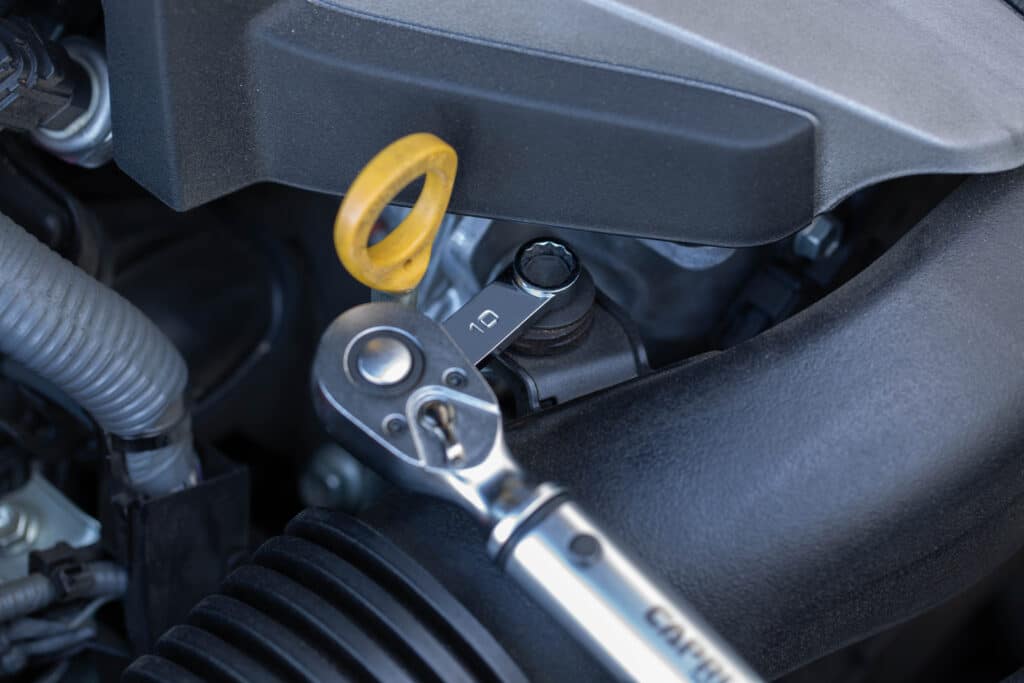
Torque adapters are specialized attachments that are designed to fit onto a torque wrench and extend its reach or adapt its drive size for specific applications. The main advantage of a torque adapter is that it allows you to apply torque to fasteners in tight or hard-to-reach places where a regular torque wrench might not fit.
However, because the adapter extends the effective length of the wrench, the torque reading can change. To ensure you’re applying the correct torque, a simple formula must be used to adjust for the difference.
Adjusting Torque: The Formula
When using a torque adapter, you need to take into account the added length of the adapter, which changes the leverage and affects the actual torque applied to the fastener. Fortunately, the formula to adjust torque is straightforward.
Here’s the torque adjustment formula:

Where:
- Set Torque is the torque setting you have on your torque wrench.
- Wrench Length is the distance from the center of the handle to the square drive where the adapter attaches.
- Adapter Length is the distance from the center of the square drive on the wrench to the center of the adapter’s drive.
Let’s break it down further with an example.
Example: Using a 3/8″ Drive Torque Adapter
Let’s say you have a 3/8″ drive torque wrench set to apply 50 ft-lb of torque, and you’re using an adapter that adds an extra 2 inches to the wrench length. The wrench length is 10 inches from the handle to the drive.
- Set Torque = 50 ft-lb
- Wrench Length = 10 inches
- Adapter Length = 2 inches
Using the formula:

So, to apply an actual torque of 50 ft-lb, you would need to set your torque wrench to 41.67 ft-lb when using the 2-inch adapter.
Example: Using a 1/2″ Drive Torque Adapter
Now, let’s look at an example using a 1/2″ drive torque wrench set to 100 ft-lb with an adapter that adds 3 inches to the wrench length. The wrench length is 12 inches.
- Set Torque = 100 ft-lb
- Wrench Length = 12 inches
- Adapter Length = 3 inches
Using the formula:

In this case, to apply an actual torque of 100 ft-lb, you would set your wrench to 80 ft-lb with the 3-inch adapter.
Practical Tips for Using Torque Adapters
- Always Use the Formula: It’s crucial to calculate the adjusted torque when using an adapter. Failing to do so could lead to either over-tightening or under-tightening the fastener, both of which could cause damage.
- Measure Adapter Length Accurately: The adapter length is measured from the center of the square drive where the adapter attaches to the center of the drive where the socket attaches. Accurate measurement is essential for proper torque adjustments.
- Use High-Quality Torque Wrenches and Adapters: Always ensure that both your torque wrench and adapter are high quality and properly calibrated. This ensures the highest level of accuracy, especially when working with critical components.
- Follow Manufacturer’s Torque Specs: Make sure to follow the torque specifications provided by the manufacturer of the component or fastener you’re working on. Each application may have unique requirements that need to be followed closely.
Torque adapters in 3/8″ and 1/2″ drive sizes are incredibly useful tools for those hard-to-reach fasteners, but they require careful use of torque calculations to ensure accuracy. By using the torque adjustment formula, you can maintain precise control over your torque applications, ensuring that everything is tightened to the correct specification. Whether you’re working on automotive, industrial, or mechanical applications, the right torque adapter can help you complete your job with confidence and accuracy.